
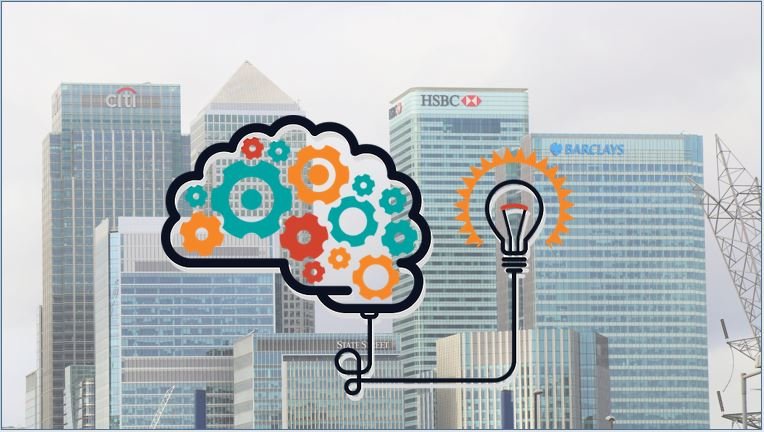
The banking industry is facing unprecedented changes. From the assault launched by various FinTech companies, to the shifting customer needs and expectations, banks need to transform itself to remain relevant in the digital age. This disruption marks the beginning of the banking sector’s new strategies, a mix of advances in business models, agile execution, and Design Thinking.
Over the past decade, “design thinking” has become the leading approach for any design. With the need for creating “experiences” on the rise this becomes even more important than ever! Whether being used to design businesses, products or services, design thinking has swept through nearly all industries. Design-thinking can often lead to innovative solutions that may revolutionize a business or even entire industries (e.g. iphone). Design-thinking achieves these results by putting customers at the center of a multi-disciplinary structured design process.
What is Design Thinking?
According to Steve Jobs, “Design is not just what it looks like and feels like. Design is how it works.” Design thinking is generally confused with visual design however, it’s the user-focused attitude to problem solving and is less about thinking and more about doing.
In a digital world with many choices, customers expect ease of use designed into every communication they have with the bank and they need to deliver on that speedily, before their competitors, which now include retailers and other non-banking financial institutes. We can rather say that Design thinking is shifting bank operations away from “managing” and more toward innovating. It is more of a combination of analytical thinking and intuitive thinking. Major players of the financial world are transitioning their processes, placing the consumer experience before their business and design thinking is at the forefront.
What is the definition of design thinking in the banking process?
Design Thinking in banking is a five-stage process used to develop digital financial products and consists of the following steps: Empathize, Define, Ideate, Prototype, Test.

What is DesignOps?
The wide spread adoption of agile development requires a strong level of integration between design and technology. There is also a real expectation to find a way to deliver design at scale in order to meet the consistency and optimize challenges of increasingly complex projects. DesignOps has become a hot buzz word and an increasing number of organizations are introducing a design operation function to support their teams. It is a clearly needed in times of transformation and to develop long-term high-performance teams.
DesignOps is the combination of practices and tools that increases an organization’s ability to quickly deliver quality UX. The role of DesignOps is, therefore, to optimize the execution of projects as a whole, with the least possible friction at each stage. The aim is to establish robust and efficient processes that deliver qualitative and measurable results.
Use cases of Design Thinking:
Bank of America developed “Keep the Change” program using each step in the design thinking process to create an innovative, customer-driven product.
- Empathize: The Design team interviewed baby boomer women with children about how they managed their finances.
- Define: Based on the learnings, the team decided to zero in on the issue of saving on a very tight budget.
- Ideate: “Keep the Change” idea was one among 80 different product ideas generated during brainstorming sessions that involved software engineers, finance experts, and other stakeholders across Bank of America.
- Prototype: To field-test the idea, design team made an infographic video about the service that could be shared with customers for feedback.
- Test: Based on feedback from customers and stakeholders, the Design team added new features to their prototype including more detailed reporting and overdraft protection.
State Street Bank used design thinking process (customer feedback and research) to refine functionality for its award-winning trading platform, Iris, which is designed to easily incorporate new technologies like blockchain and machine learning.
Using design thinking process, National Australian Bank developed a lending solution platform for small businesses that answered users need for a simple process and speedy decisions.
While launching a new investment product OCBC Bank used design thinking process to figure out how the product should be promoted to clients. They asked front-line employees to brainstorm the different communication materials and messages. By incorporating the insights of the people actually selling the product, OCBC Bank increased sales of the new product by 150%.
Conclusion:
Design thinking isn’t just useful for launching new products and services. It can also help banks reimagine how to promote existing ones. Banks have a great deal to gain from engaging with design thinking principles. The process of empathizing with end-users pain points, brainstorming creative solutions and iterating on prototypes yields good products and services which are loved by end-users thereby keeping traditional financial institutions competitive in the digital age.
#Fintech #Design #DesignThinking #DesignOps #CustomerExperience #Agile #UIUX #Technology #Banking #UserExperience #InnovativeSolutions #AnalyticalThinking #IntuitiveThinking #Empathize #Ideate #Prototype #Brainstorm #PainPoints
#Strategy #Management #Consulting #Transformation #Technology #Outsourcing #CreativeDisruptions #EternalQuest #FindingTruth
 Randomness Pattern